

The increasing availability of digital maritime information has created new requirements for the way data is delivered, accessed and exchanged between vessels and shore-based services. Standardised data formats are an important part of this process, but they do not, on their own, ensure that different systems can communicate securely or use compatible interfaces. A common technical framework is also needed to support the exchange of information across different maritime applications and service providers.
SECOM (Secure Communication between Ship and Shore) addresses this requirement through a standardised approach to maritime data exchange. Defined by the International Electrotechnical Commission (IEC) under IEC 63173-2, SECOM specifies interfaces for information services, security mechanisms and service discoverability. Although developed with the IHO S-100 framework in mind, it is not limited to S-100 data products and can accommodate other information formats.
The second edition of the standard, commonly referred to as SECOM 2.0, represents the next stage in its development, reflecting the continued evolution of maritime digital services and their interoperability requirements.
The Need for Standardised Maritime Communication
Maritime information is exchanged between a variety of systems and organisations. Hydrographic offices, maritime authorities, port operators, vessel operators and commercial service providers all generate or manage information that may need to be accessed by other parties.
In the absence of common communication interfaces, each service may require a different approach to data exchange. This can result in multiple technical integrations, separate access procedures and additional complexity for organisations seeking to connect their systems.
These challenges become particularly relevant when vessels need to access information from different service providers during a voyage. A vessel may require navigational warnings, water level information, bathymetric data or other operational information originating from different sources.
SECOM provides a standardised technical framework for these interactions. By defining common service interfaces and supporting mechanisms for secure communication and service discovery, it facilitates interoperability between information services without requiring them to share the same internal infrastructure or operational purpose.
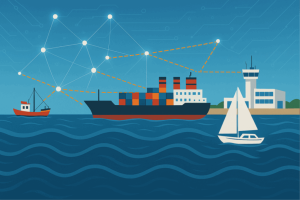
Ship-to-shore connectivity. Source: IALA
How SECOM Works
SECOM defines a set of technical interfaces and security provisions that allow maritime information services to exchange data. Its framework is based on three main functional areas.
Information Service Interfaces
At the core of SECOM are standardised Application Programming Interfaces (APIs) for data exchange. These interfaces define how information services communicate, providing a common technical structure for exchanging information between different systems.
Communication between SECOM information services relies on IP-based web services, using standardised interfaces that can support different operational applications.
Importantly, SECOM does not prescribe the physical communication technology used for the entire connection between a vessel and a service. Satellite communications, cellular networks and other communication technologies can be used, provided that the relevant requirements for communication between SECOM services are met.
Information Security
Security is an essential element of the SECOM framework. Information exchanged between maritime services may be operationally sensitive and must be protected against unauthorised access or manipulation.
SECOM incorporates mechanisms for secure communication, including encryption, authentication and digital certificates supported by Public Key Infrastructure (PKI). These mechanisms help establish trust between communicating services and support the verification of information sources.
Digital signatures can also be used to verify the authenticity and integrity of exchanged data, providing an additional layer of protection for maritime information.
Service Discoverability
In addition to data exchange and security, SECOM addresses the identification of available information services.
Service discoverability allows compatible systems to identify relevant services and obtain the necessary information to access them. This is particularly useful in an international maritime environment, where vessels may need information from service providers they have not previously interacted with.
Through standardised service discovery interfaces, SECOM supports a more structured way of locating maritime information services, reducing dependence on individually configured connections to each provider.
Together, these functions provide a common technical basis for the secure exchange of information between maritime services.
SECOM and the IHO S-100 Framework
The development of SECOM is closely connected to the transition towards the IHO S-100 Universal Hydrographic Data Model.
S-100 provides a common framework for the development and exchange of digital hydrographic and maritime information products. It supports a growing range of datasets, including Electronic Navigational Charts (S-101), Bathymetric Surface (S-102), Water Level Information for Surface Navigation (S-104), Surface Currents (S-111) and Navigational Warnings (S-124).
As these products become increasingly integrated into digital navigation systems, reliable mechanisms for their distribution and exchange become equally important.
SECOM complements S-100 by addressing the communication layer between information services. While S-100 defines how maritime information is structured and modelled, SECOM provides standardised interfaces and security mechanisms for exchanging that information between services.
SECOM is also relevant to the wider Maritime Connectivity Platform (MCP), which provides a decentralised framework for secure and reliable information exchange within the maritime domain. The two are complementary: MCP provides infrastructure and services for maritime connectivity, including identity and service registries, while SECOM defines standardised interfaces for secure data exchange between information services. Their relationship is also reflected in the SECOM standard, which describes an MCP-based implementation as an example of its security architecture.
For example, a shore-based service could provide a vessel with navigational warning information through a SECOM-compatible interface. Similarly, a vessel could transmit a route plan to a shore-based service, which could use that information to provide additional operational data.
SECOM therefore supports the practical exchange of S-100-based information while remaining applicable to other data formats and maritime services.
SECOM 2.0 and the Second Edition of IEC 63173-2
The first edition of IEC 63173-2 was published in May 2022, establishing the initial international standard for secure communication between ship and shore.
The second edition, IEC 63173-2 Edition 2.0, is part of the ongoing revision of the standard within IEC Technical Committee 80, responsible for maritime navigation and radiocommunication equipment and systems.
As of November 2026, the second edition has entered the Draft International Standard (DIS) ballot stage. Technical test material aligned with the Committee Draft for Vote (CDV) of Edition 2.0 has also been made available through CIRM, supporting the testing and implementation of SECOM-compatible systems.
The revision is part of the continued development of the standard as maritime information services and interoperability requirements evolve. However, the second edition remains under development and should be distinguished from the published IEC 63173-2:2022 standard.
This distinction is important when referring to SECOM 2.0, as the technical provisions of the final edition may differ from those contained in the current draft.
SECOM in the Maritime Digital Environment
The ability to exchange information securely across different maritime systems is an important requirement for the development of interconnected digital services.
SECOM provides a common technical approach to this requirement, supporting communication between vessels, shore-based services and maritime information providers. Its compatibility with S-100-based products also makes it relevant to the wider adoption of interoperable hydrographic and navigational information.
As the maritime sector continues to expand its digital infrastructure, standardised communication frameworks such as SECOM are expected to play an important role in connecting information services and supporting more consistent access to maritime data.
References
- International Electrotechnical Commission (IEC). (2022). IEC 63173-2:2022 – Maritime navigation and radiocommunication equipment and systems – Data interfaces – Part 2: Secure communication between ship and shore (SECOM). IEC Webstore
- International Hydrographic Organization (IHO). (2023). Introduction of S-100 Data Services with IEC 63173-2 (SECOM). S-100 Working Group, Paper S-100WG8-6.7. IHO Document
- CIRM. IEC 63173-2 SECOM – Test Material and Implementation Resources. CIRM
- IEC Project 63173-2 Edition 2. Maritime navigation and radiocommunication equipment and systems – Data interfaces – Part 2: Secure communication between ship and shore (SECOM). Project Status