
As maritime operations become increasingly digital, the ability to exchange information securely and reliably is becoming essential. Ships, ports, hydrographic offices, maritime authorities and service providers all depend on timely access to information. Yet connecting these systems can be challenging when they operate through different technologies, communication channels and digital infrastructures.
The Maritime Connectivity Platform (MCP) addresses this challenge by providing a framework for secure and reliable information exchange across the maritime domain and beyond. Rather than replacing existing maritime systems, MCP aims to connect digital services and their users through common mechanisms for identity management, service discovery and communication.
As the maritime industry moves towards more integrated digital operations, MCP provides an important foundation for improving interoperability and enabling new forms of collaboration between maritime stakeholders.
Beyond Isolated Maritime Systems
Maritime information is produced and managed by a wide range of organisations, from hydrographic offices and port authorities to vessel operators and commercial service providers. Each may operate its own digital services, databases and communication infrastructure.
Although these systems serve specific operational needs, exchanging information between them can require dedicated integrations and different authentication procedures. Discovering available services and establishing trusted communication can therefore become increasingly complex as the number of digital applications grows.
MCP offers a common approach to these challenges. It is designed as a decentralised platform, meaning that no single organisation needs to operate the entire ecosystem. Different organisations can provide platform services while following common requirements that support interoperability.
This approach can facilitate information exchange between vessels and shore-based services, as well as between different organisations and digital platforms. The information exchanged can range from public navigational warnings to operational information shared privately between a vessel and its shore office.
How the Maritime Connectivity Platform Works
MCP is built around three core components, each addressing a different aspect of maritime connectivity.
Maritime Identity Registry (MIR)
The MIR supports the identification and authentication of maritime entities, including organisations, people, vessels, devices and digital services. It helps establish trusted digital identities and provides mechanisms that can be used to support secure access to compatible services.
By enabling systems to recognise and authenticate participating entities, the MIR helps establish a foundation for trusted communication across organisational boundaries.
Maritime Service Registry (MSR)
The MSR supports the registration and discovery of digital maritime services. It can be understood as a specialised directory through which users and systems can identify available services and relevant access information.
For example, a service provider could make information about an available maritime service discoverable, allowing potential users to identify services that meet their operational requirements without having to know every provider in advance.
Maritime Messaging Service (MMS)
The MMS is designed to support messaging between authorised maritime stakeholders. It can facilitate communication across different communication systems and help deliver messages to their intended destinations.
This is particularly relevant in the maritime environment, where vessels may operate beyond the reach of continuous terrestrial connectivity and may rely on different communication links during a voyage.
Together, these components address three complementary needs: establishing trusted identities, discovering available services and facilitating communication.
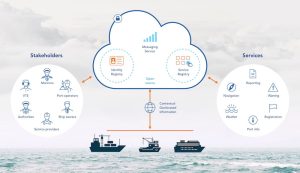
The MCP Ecosystem. Source: Baltic Transport Journal
A Decentralised Approach to Maritime Connectivity
An important characteristic of MCP is its decentralised architecture. Rather than requiring all digital services to be hosted or controlled by one central organisation, the platform allows multiple providers to participate in a shared connectivity ecosystem.
This model can support cooperation between public authorities, commercial service providers and other maritime organisations while allowing them to retain responsibility for their own services.
Common requirements and governance arrangements help participating providers work towards interoperability. The Maritime Connectivity Platform Consortium (MCC) plays a central role in defining the platform framework and the criteria for organisations providing MCP services.
MCP also supports the use of Maritime Resource Names (MRNs), which provide standardised identifiers for maritime entities and resources. Such identifiers help systems refer to vessels, organisations and services consistently across different applications.
By combining common identifiers, identity mechanisms and service discovery, MCP provides a framework for connecting services without requiring every participant to build an entirely separate integration for each new relationship.
Supporting Digital Maritime Services
The value of MCP becomes clearer when considering how digital maritime services can be used in practice.
Potential applications include:
- Navigational information: Supporting the discovery and exchange of information services provided by maritime authorities and other relevant organisations.
- Port and vessel operations: Facilitating digital communication between vessels, port-related services and shore-based stakeholders.
- Aids to Navigation (AtoN): Supporting access to services providing information about navigational aids within relevant areas.
- Hydrographic data services: Helping users discover services that provide electronic navigational charts and other hydrographic information.
- Maritime logistics: Supporting information exchange between maritime stakeholders and related transport or logistics services.
These examples illustrate the range of services that MCP can help connect. The availability and functionality of each application depend on the participating services, their technical implementation and the relevant access and security arrangements.
MCP and the Evolution of E-Navigation
The development of e-navigation is increasing the importance of reliable digital communication between ships and shore-based organisations. As maritime information becomes available through a growing number of services, common approaches to connectivity can help reduce fragmentation and improve access to relevant information.
MCP aligns with this wider direction by providing mechanisms for identity management, service discovery and messaging. These capabilities can complement standards that address other parts of the digital maritime environment, including the IHO S-100 Universal Hydrographic Data Model.
While S-100 defines how particular categories of hydrographic information are structured and exchanged, MCP addresses the broader connectivity environment in which digital services can be identified and accessed. Communication standards such as SECOM address a related but distinct requirement: how information is exchanged through standardised interfaces and security mechanisms.
These technologies therefore serve complementary purposes. Together, they can contribute to a more connected maritime information environment in which data products and digital services can work across organisational and technical boundaries.
From Connectivity Framework to Practical Implementation
Realising the potential of MCP requires more than defining common technical principles. It also depends on service providers implementing compatible components, organisations establishing appropriate trust relationships and participating systems being tested for interoperability.
Test environments are important in this process because they allow maritime stakeholders and developers to explore the platform’s capabilities and evaluate how different services interact before wider operational deployment.
The MCP Consortium, together with its members and partners, supports the development of technical specifications, reference implementations and testing resources. An MCP test instance endorsed by the International Association of Marine Aids to Navigation and Lighthouse Authorities (IALA) is also available to relevant maritime stakeholders for developing and testing digital maritime services.
Such initiatives help translate the connectivity framework into practical implementations and provide opportunities to identify technical challenges as the ecosystem evolves.
Building a More Connected Maritime Future
As maritime operations become more data-driven, the ability to connect services securely and efficiently is becoming increasingly important. The challenge is not only to make information available, but also to ensure that relevant services can be discovered, trusted and accessed by the appropriate users and systems.
The Maritime Connectivity Platform provides a framework for addressing this challenge through common mechanisms for identity management, service discovery and messaging. Its decentralised approach creates opportunities for organisations to participate in a wider digital ecosystem while continuing to operate their own services.
As e-navigation and digital maritime services continue to develop, MCP can help establish the connectivity needed to bring information and applications closer together.
The future of digital maritime operations will depend not only on the quality of the information being produced, but also on how effectively different systems and organisations can connect. MCP provides an important foundation for that evolution.
References
- Maritime Connectivity Platform Consortium (MCC). The Maritime Connectivity Platform. https://maritimeconnectivity.net/
- Maritime Connectivity Platform Consortium (MCC). Maritime Connectivity Platform Documentation. https://docs.maritimeconnectivity.net/en/latest/
- International Association of Marine Aids to Navigation and Lighthouse Authorities (IALA). MCP Test Instance. https://www.iala.int/mcp-test-instance/
- International Hydrographic Organization (IHO). S-100 Project — The Universal Hydrographic Data Model. https://iho.int/en/s100-project